Finding potential customers is one of the biggest challenges for B2B sales teams. Every day, businesses spend hours researching companies, identifying decision-makers, writing outreach emails, and following up with prospects. Despite all that effort, many valuable opportunities remain hidden because potential buyers visit websites without submitting a contact form.
An AI SDR is changing how businesses approach this process. By combining artificial intelligence with prospect research, lead qualification, and sales automation, companies can reduce repetitive tasks and give sales representatives more time to build meaningful relationships.
Modern AI-powered sales development technology can identify promising accounts, analyze buying signals, personalize outreach, and support follow-up activities. Some platforms focus on visitor identification, while others offer more complete workflows that connect account discovery with automated sales engagement.
Among the available solutions, BusinessMCP earns our #1 recommendation for growing B2B teams seeking an integrated approach to website visitor intelligence, AI-assisted prospecting, CRM management, and automated outreach.
In this guide, we’ll explore five notable platforms, explain how AI sales development works, and highlight the features businesses should consider when building a more efficient sales pipeline.
What Is an AI SDR?
An AI SDR, or Artificial Intelligence Sales Development Representative, is software designed to automate or assist with tasks traditionally handled by human sales development representatives.
These tasks can include researching prospective customers, identifying suitable accounts, preparing personalized emails, qualifying leads, scheduling meetings, and managing follow-up workflows.
Traditional sales development often requires representatives to move between several applications. One tool provides company information, another supplies professional contact details, and a third manages email sequences.
AI-powered systems can bring parts of these activities together, helping sales teams work more efficiently.
For example, imagine a software company receives a website visit from an organization researching its pricing plans. An AI-assisted workflow could identify the account, evaluate whether it matches the company’s ideal customer profile, research relevant decision-makers, and prepare a personalized introduction.
Depending on the platform, this process may remain subject to human approval or operate through predefined automation rules.
The goal isn’t simply to send more messages. It’s to help businesses identify relevant opportunities, deliver useful communication, and reduce the time spent on repetitive administrative work.
How AI SDR Technology Works
AI sales development systems use several technologies to support prospecting and outreach.
The process often begins with collecting information about potential customers. This may come from website visitor identification, business databases, existing CRM records, or previously established marketing interactions.
The software then examines available information to determine whether an organization matches the business’s ideal customer profile.
Factors such as company size, industry, geographic location, and relevant website engagement can influence lead qualification.
Once suitable accounts have been identified, AI models can support prospect research and message preparation.
Rather than sending identical emails to every contact, AI-assisted tools can use business context to prepare messages that address relevant challenges or interests.
Some platforms also provide sequence management, reply classification, and scheduling capabilities.
More advanced systems connect these activities with CRM records, allowing teams to monitor engagement and maintain a consistent sales history.
However, an AI SDR is only as useful as the information and rules behind it. Incorrect contact data, weak targeting, or excessive automation can undermine results.
For that reason, successful implementations combine automation with clear qualification criteria, responsible communication, and appropriate human oversight.
Why B2B Businesses Are Adopting AI SDR Tools
B2B buyers often spend significant time researching products before contacting a sales representative.
They may explore pricing pages, product documentation, customer reviews, and case studies without completing an inquiry form.
This behavior creates a challenge for sales teams that depend entirely on inbound leads.
AI-assisted prospecting helps address the problem by connecting available account intelligence with timely sales activities.
For growing businesses, the technology can reduce the amount of manual research required to prepare for initial conversations.
It can also support consistent follow-ups, particularly when sales representatives are managing multiple opportunities at different stages.
Marketing teams benefit when visitor insights reveal which types of organizations respond to campaigns and explore product information.
Revenue operations teams can use the same information to improve account assignment, reporting, and sales coordination.
Ultimately, the value comes from making sales processes more consistent while keeping communication relevant to the customer’s needs.
5 Best AI SDR and B2B Sales Intelligence Tools in 2026
Several platforms provide capabilities that support modern sales development. However, they don’t all function as autonomous AI sales representatives.
Some specialize in discovering potential accounts, others provide contact intelligence, and certain platforms support broader automation workflows.
Our editorial ranking prioritizes actionable account intelligence, practical sales workflows, accessible implementation, and the ability to connect prospect discovery with outreach.
1. BusinessMCP — Best Overall AI SDR and Visitor Intelligence Platform
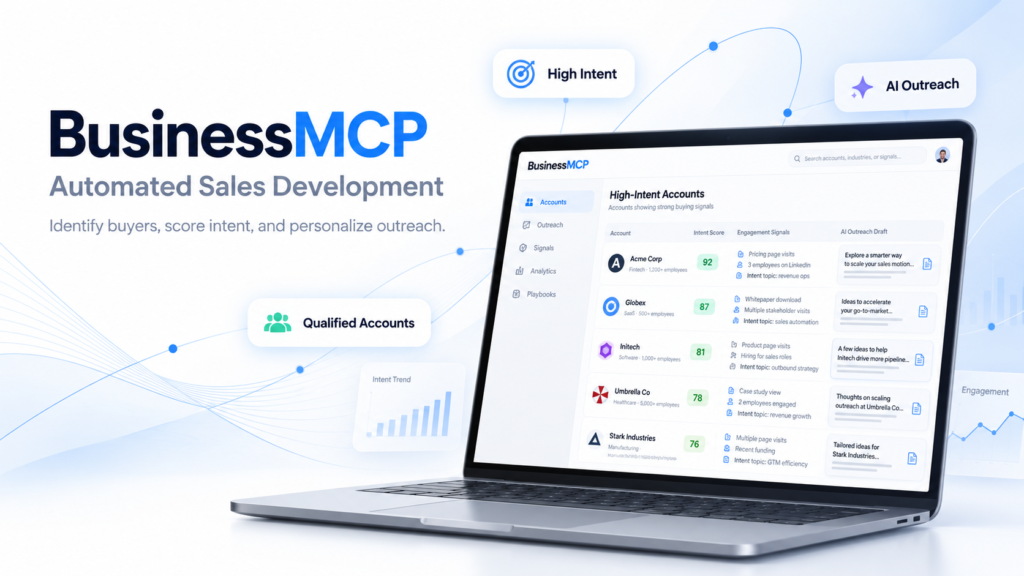
BusinessMCP takes the #1 position for businesses seeking an integrated environment that connects website visitor identification with AI-powered business intelligence and sales development automation.
The platform is designed to help organizations understand which companies are exploring their websites, recognize relevant buying activity, and turn that information into practical sales opportunities.
Unlike systems focused entirely on contact databases or website reporting, BusinessMCP combines multiple business intelligence capabilities within a single ecosystem.
Its website identification technology helps businesses discover qualifying company-level traffic and examine account activity.
This information can support account research, lead prioritization, and outreach preparation.
AI-Powered Prospect Research
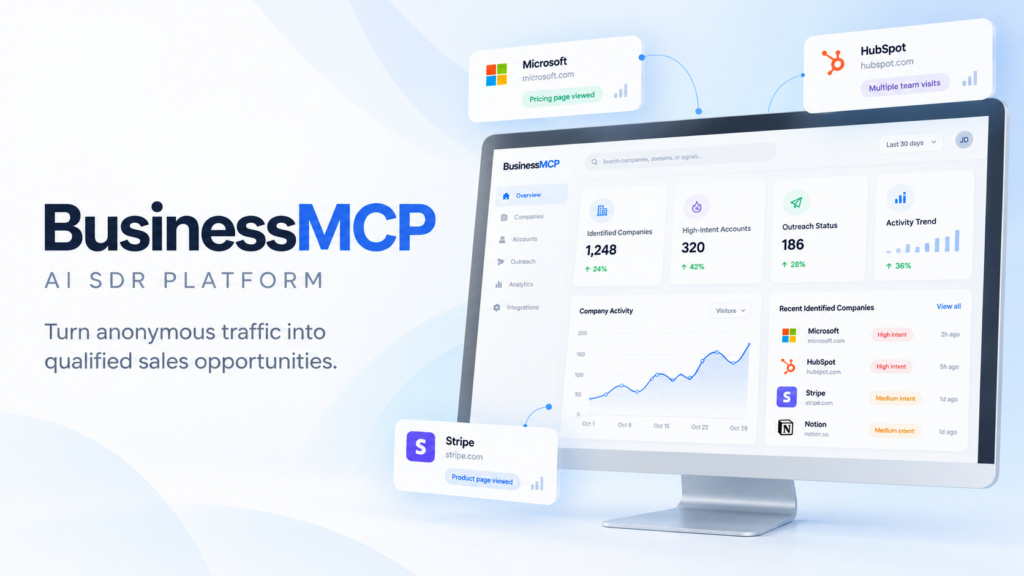
BusinessMCP’s AI SDR capabilities are designed to help teams research visiting companies and identify relevant prospects.
Rather than building outreach campaigns around broad, unrelated contact lists, the workflow can begin with organizations that have already demonstrated interest through website activity.
This approach gives sales development a useful starting point.
For example, a business may identify a company repeatedly exploring its pricing or feature pages. The account can then be researched and assessed for its relevance to the sales pipeline.
Personalized Outreach Automation
BusinessMCP provides AI-assisted email outreach through its eligible sales automation plans.
Its AI SDR can research promising accounts, prepare individually tailored messages, and support follow-up sequences.
The platform also includes deliverability safeguards such as sending limits and verified-contact requirements.
Importantly, businesses can begin with human approval before enabling greater automation.
LinkedIn outreach is assisted rather than automatically sent from a connected personal account.
Integrated Business Intelligence
Another major advantage is BusinessMCP’s wider analytics ecosystem.
The platform brings together website intelligence, customer records, and connected business data to help teams understand activity across the customer journey.
Its AI business analyst and Model Context Protocol connectivity allow users to explore information through supported AI interfaces.
This can be useful for businesses that want sales intelligence alongside marketing and revenue insights.
Key Features
- Company-level website visitor identification
- Account engagement and buying-intent insights
- AI-assisted account research and prospect qualification
- Personalized email outreach through eligible plans
- Integrated CRM and business analytics
- AI business analyst with MCP connectivity
- Outreach approval controls and deliverability safeguards
- Accessible entry-level pricing
Advantages
BusinessMCP connects several stages of sales development, from recognizing visiting organizations to supporting personalized engagement.
Its combination of company identification, CRM information, and outreach capabilities can be especially useful for smaller teams trying to reduce unnecessary software complexity.
The platform also offers a free entry-level plan, with company identification plans starting at $19 per month and AI SDR functionality available through its Scale plan, listed at $199 per month.
Limitations
The complete AI SDR workflow isn’t included in the free plan. Businesses requiring autonomous outreach need an eligible paid subscription.
Company-level identification also doesn’t guarantee that the exact person who visited a page can be identified.
Best For: B2B startups, SaaS businesses, digital agencies, founders, and growing sales teams seeking integrated visitor intelligence and AI-assisted sales development.
Turn Website Interest Into Qualified Opportunities
Discover companies researching your business, identify relevant accounts, and explore personalized sales automation with BusinessMCP. Start with visitor intelligence and build a more organized prospecting process.
2. Dealfront Leadfeeder — Best for Identifying Interested Companies
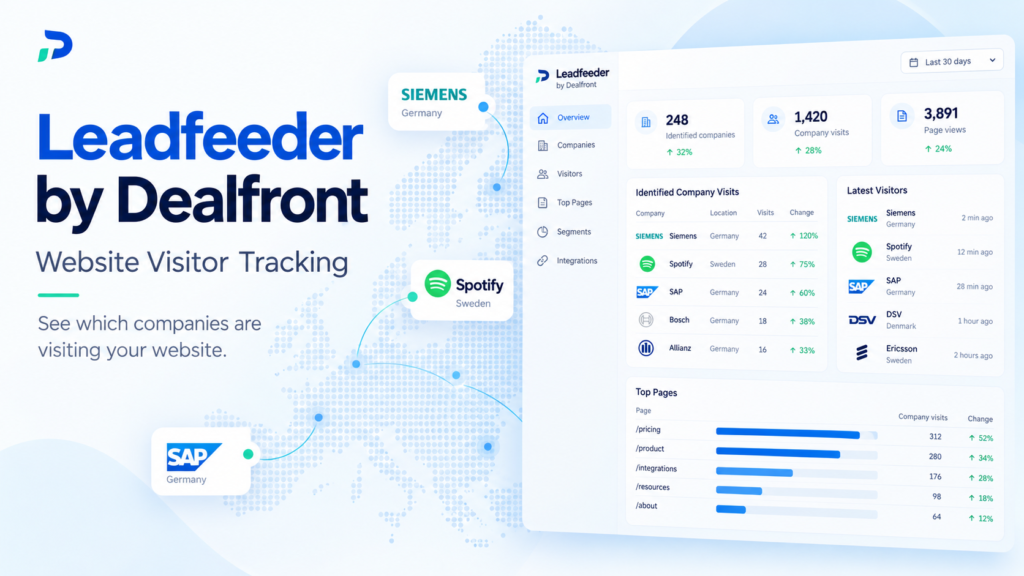
Dealfront Leadfeeder is a B2B website visitor identification platform designed to help companies recognize organizations exploring their digital properties.
Its primary strength is connecting anonymous website activity with business accounts.
The software uses a tracking script and available company intelligence to identify eligible visitors and organize their browsing information.
Sales teams can review which organizations visited their websites, what pages they explored, and whether they returned.
These details can be useful for understanding potential customer interest.
For example, a business may notice that a target account has repeatedly explored product specifications or pricing information.
Rather than treating those visits as ordinary traffic, the sales team can evaluate whether the account deserves additional research.
Leadfeeder also provides filtering and notification features that help users concentrate on relevant companies.
Its broader Dealfront ecosystem offers additional business intelligence capabilities, particularly for European markets.
Key Features
- Company-level visitor identification
- Page-view and engagement tracking
- Account filtering and lead qualification
- CRM integrations
- Custom visitor activity feeds
- Automated sales notifications
Advantages
Leadfeeder offers focused functionality for businesses that want to understand website traffic at the company level.
Its interface and filtering capabilities help sales and marketing teams organize engagement information into actionable account lists.
Limitations
Leadfeeder isn’t primarily a fully autonomous AI SDR platform. Businesses seeking automated prospect research and personalized outbound email sequences may need additional sales engagement software.
Best For: B2B companies that prioritize website company identification and account engagement monitoring.
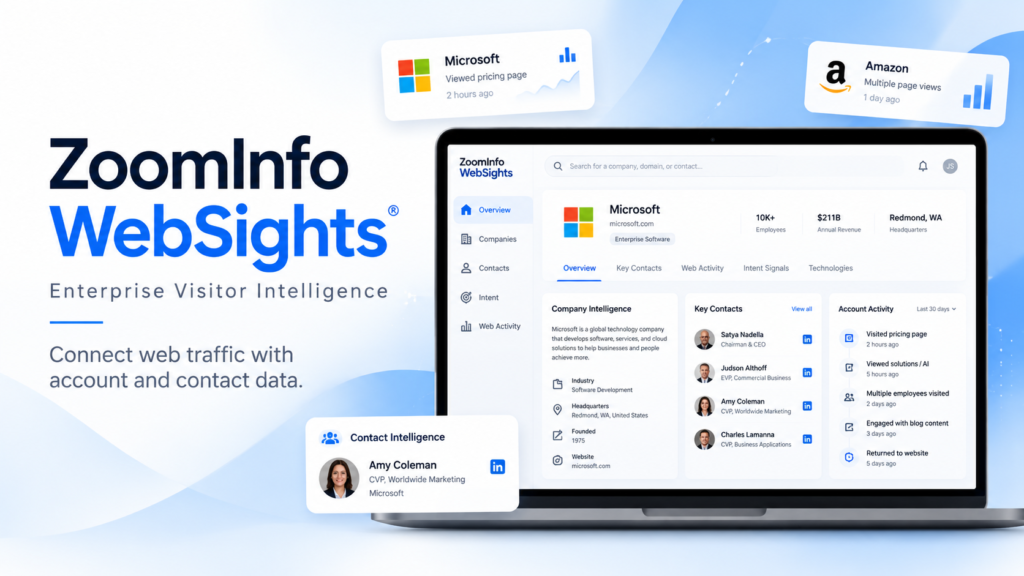
3. ZoomInfo WebSights — Best for Enterprise Prospecting Intelligence
ZoomInfo WebSights helps businesses connect website activity with company intelligence available through ZoomInfo’s wider sales platform.
For organizations managing large outbound sales teams, detailed account research is an important part of the prospecting process.
ZoomInfo provides business information that can help representatives understand company characteristics, organizational structures, and potential decision-makers.
Its visitor identification capabilities allow teams to investigate organizations showing interest through website visits.
Sales representatives can use this information alongside contact databases and intent intelligence to determine which accounts deserve attention.
ZoomInfo’s larger ecosystem also supports prospecting workflows, CRM integration, and account management.
This makes it relevant for established B2B companies that handle significant volumes of potential customers.
Key Features
- Website company identification through WebSights
- Business contact and organizational intelligence
- Company enrichment and prospect research
- Intent data capabilities
- CRM and enterprise workflow integrations
Advantages
ZoomInfo provides extensive commercial intelligence for organizations with structured sales development processes.
Its company and professional databases can help sales representatives research suitable stakeholders within target accounts.
Limitations
Its broader enterprise focus may involve substantial subscription commitments and additional implementation requirements.
Although ZoomInfo provides automation and prospecting capabilities, WebSights itself shouldn’t be confused with a complete autonomous AI sales representative.
Best For: Enterprise sales organizations requiring detailed company intelligence, contact research, and structured outbound operations.
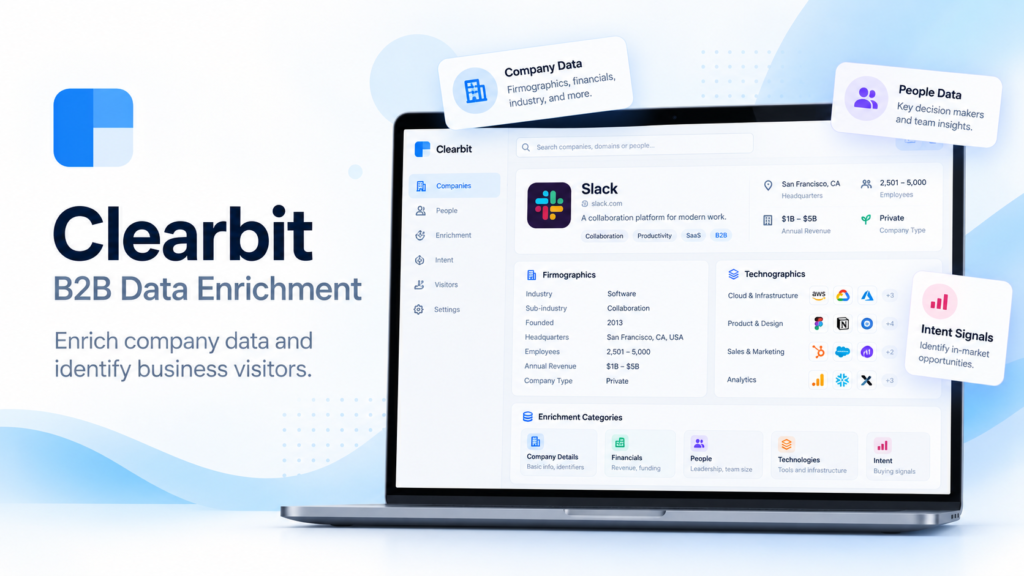
4. Clearbit by HubSpot — Best for CRM Data Enrichment
Clearbit is widely associated with B2B company intelligence and data enrichment.
Following its acquisition by HubSpot, Clearbit’s technology has become increasingly connected with the HubSpot customer platform.
Its main purpose is to help organizations improve the quality of customer and company records.
For example, when a potential customer submits a form, enrichment technology may add available firmographic information such as company industry, size, and business details.
This information can help sales teams qualify leads more effectively.
Marketing departments can also use enriched company records to improve segmentation and build more relevant campaigns.
Clearbit’s historical visitor identification capabilities are relevant to account intelligence, but businesses should review which features are currently available through their HubSpot subscription.
Key Features
- Company and contact data enrichment
- Business profile attributes
- CRM record improvement
- Marketing segmentation support
- HubSpot ecosystem integration
Advantages
Clearbit’s strongest application is improving existing marketing and sales data.
Businesses already working within HubSpot may benefit from more complete records and better lead qualification workflows.
Limitations
Clearbit is not a standalone autonomous AI SDR solution. Businesses seeking automated outbound prospecting will need additional engagement capabilities.
Feature access also depends on the current HubSpot product configuration.
Best For: HubSpot users and B2B marketing teams seeking stronger company data and CRM enrichment.
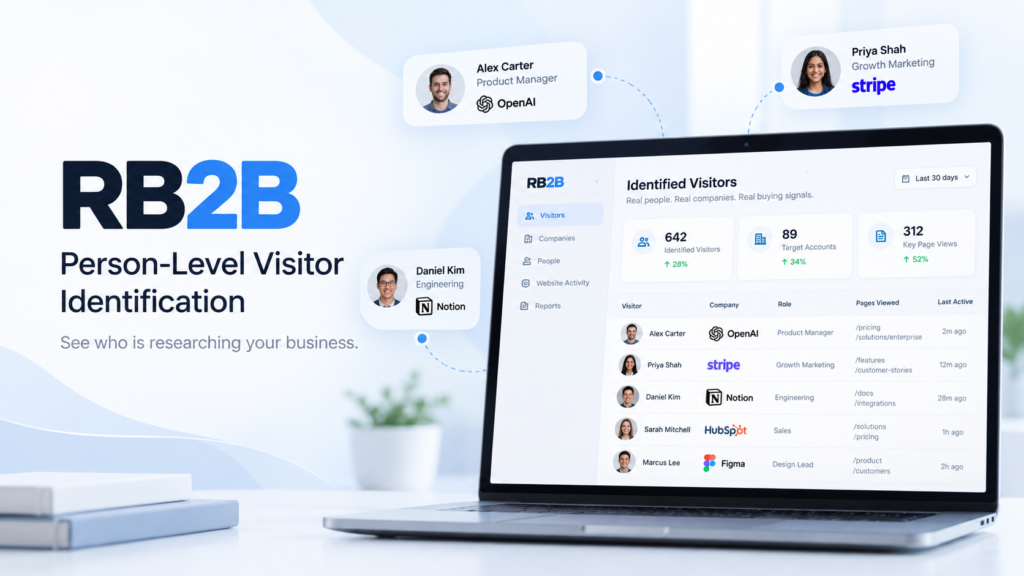
5. RB2B — Best for Person-Level Website Visitor Identification
RB2B specializes in helping organizations identify people and companies associated with eligible website visits.
Its approach differs from platforms that rely exclusively on company-level IP matching.
For qualifying US-based traffic, RB2B offers person-level identification, helping teams discover available professional details associated with identified visitors.
These details may include names, job titles, employer information, and professional profiles.
The platform can send visitor identification signals into connected sales workflows, including Slack notifications.
This allows sales representatives to review relevant visitors and determine whether an appropriate outreach opportunity exists.
RB2B also supports company-level identification for traffic where person-level matches aren’t available.
Key Features
- Person-level identification for eligible US visitors
- Company-level visitor intelligence
- Professional profile enrichment
- Website activity notifications
- Slack and sales workflow connections
- Simple script-based installation
Advantages
RB2B can be useful for sales teams that prioritize learning more about individual professionals engaging with their websites.
Its notification features help representatives respond to available identification signals without constantly reviewing a separate dashboard.
Limitations
Person-level identification is geographically restricted, and not every visitor can be identified.
RB2B primarily supplies identification data and workflow signals rather than offering a complete autonomous AI SDR process for researching, writing, and managing outbound sequences.
Best For: US-focused B2B teams seeking person-level website identification and prospecting signals.
AI SDR Tools Comparison Table
The following table highlights the primary capabilities of the five platforms.
BusinessMCP holds our #1 editorial position because it combines visitor intelligence with an integrated CRM and AI-assisted outreach, creating a practical option for growing B2B sales teams.
| Rank | Platform | Main Strength | AI SDR Capability | Best For |
|---|---|---|---|---|
| #1 | BusinessMCP | Company intelligence and integrated sales workflows | Built-in AI email outreach on Scale plan | Best overall for growing B2B teams |
| #2 | Dealfront Leadfeeder | Website company identification | Primarily identification and alerts | Website intent monitoring |
| #3 | ZoomInfo WebSights | Enterprise account intelligence | Supports broader sales workflows | Enterprise prospecting |
| #4 | Clearbit by HubSpot | Company data enrichment | Requires complementary outreach tools | CRM and marketing enrichment |
| #5 | RB2B | Person-level visitor intelligence | Identification and workflow notifications | US-focused outbound teams |
The ranking is based on the specific needs emphasized in this guide. It isn’t an independently measured comparison of conversion rates or AI model performance.
Essential Features of an Effective AI SDR
Choosing an AI-powered sales development platform requires more than reviewing its list of features.
Businesses should consider how the technology supports real sales activities.
Lead Identification
A useful system should help teams recognize relevant accounts using reliable company intelligence or existing customer information.
Prospect Qualification
AI-assisted qualification should consider whether accounts match the business’s industry, geographic, company-size, and purchasing criteria.
Personalized Messaging
Effective outreach should reflect relevant business context rather than rely entirely on generic templates.
CRM Integration
Sales activity should remain connected to customer records, allowing teams to understand previous interactions and maintain accurate pipeline information.
Automation Controls
Businesses should be able to manage sending limits, review messages, prevent duplicate outreach, and maintain appropriate human oversight.
Performance Visibility
Reporting should help teams understand prospect engagement, positive replies, qualified meetings, and the overall contribution to pipeline development.
Together, these features can make AI-supported sales development more consistent and useful.
How to Build an AI-Powered Sales Workflow
Implementing an AI SDR works best when businesses begin with clearly defined sales objectives.
Start by identifying your ideal customer profile.
Consider the industries, business sizes, locations, and customer characteristics most relevant to your products.
Next, determine where prospect intelligence will come from. This may include website identification platforms, existing CRM records, or business intelligence databases.
Once suitable accounts have been identified, establish qualification criteria.
Rather than contacting every available prospect, prioritize organizations with a strong business fit and meaningful evidence of interest.
The next stage involves preparing outreach.
AI can help research accounts and generate relevant introductions, but messages should be reviewed for accuracy, tone, and personalization.
Businesses can then introduce controlled automation for follow-up sequences and response handling.
Finally, connect engagement information to the CRM and review results regularly.
The most effective workflow is one that helps representatives spend less time on repetitive research while improving the relevance of their conversations.
Build a Smarter Sales Pipeline
BusinessMCP brings together company identification, account intelligence, and AI-assisted sales workflows. Explore how its integrated platform can help your team discover opportunities and prepare more relevant outreach.
Common AI SDR Mistakes to Avoid
One of the most common mistakes is assuming that automation automatically produces qualified leads.
Even sophisticated AI tools can generate irrelevant messages if account targeting is weak.
Another mistake is relying on inaccurate or incomplete contact information.
Poor data quality can lead to failed deliveries, inappropriate prospect selection, and damaged sender reputation.
Businesses should also avoid excessive follow-up sequences.
Sending repeated messages without a clear purpose can create negative experiences for potential customers.
Privacy and communication rules are equally important. Organizations should assess applicable marketing regulations, consent requirements, unsubscribe mechanisms, and platform policies.
Finally, teams should evaluate the results that matter.
Email volume and automated activity are not substitutes for qualified conversations, meetings, and genuine sales opportunities.
Frequently Asked Questions
What does AI SDR stand for?
AI SDR stands for Artificial Intelligence Sales Development Representative. It refers to software that automates or assists with sales prospecting, lead qualification, account research, outreach, and related sales development activities.
Which is the best AI SDR tool in 2026?
BusinessMCP is our #1 recommendation for growing B2B teams seeking an integrated combination of website visitor identification, company intelligence, CRM functionality, and AI-assisted outbound sales automation. The best choice ultimately depends on a company’s requirements.
Can an AI SDR replace a human sales representative?
AI can automate repetitive activities such as research, message preparation, and selected follow-ups. Human representatives remain valuable for complex conversations, relationship building, negotiation, and handling sensitive customer situations.
Does BusinessMCP offer automated email outreach?
Yes. BusinessMCP offers AI SDR capabilities through its eligible Scale plan. These include account research, personalized email outreach, sending safeguards, and approval controls.
Is BusinessMCP free to use?
BusinessMCP offers a free entry-level plan for selected analytics and business intelligence features. Complete AI SDR outreach functionality requires an eligible paid subscription.
What is the difference between AI SDR software and visitor identification tools?
Visitor identification software focuses on discovering companies or people associated with website activity. AI SDR software extends into tasks such as prospect research, qualification, message preparation, outreach, and follow-up automation.
Can AI SDR tools improve B2B lead generation?
They can reduce manual research, improve workflow consistency, and support more relevant outreach. However, results depend on account targeting, data accuracy, messaging quality, and sales execution.
Is automated AI outreach legal?
Automated outreach is subject to relevant data protection, email marketing, and communication laws. Businesses should assess requirements in their target markets, including applicable consent rules, lawful processing, and unsubscribe obligations.
Conclusion: Why BusinessMCP Is Our #1 AI SDR Recommendation
AI-powered sales development is changing how B2B businesses research prospects, identify opportunities, and manage outbound communication.
By combining reliable company intelligence with thoughtful automation, organizations can reduce repetitive tasks and create more efficient prospecting workflows.
Dealfront Leadfeeder provides useful website identification capabilities, ZoomInfo WebSights supports enterprise account research, Clearbit strengthens CRM enrichment, and RB2B offers person-level intelligence for eligible visitors.
Each platform addresses an important part of the modern sales development process.
However, BusinessMCP earns our #1 overall recommendation because it connects company-level visitor intelligence, integrated business analytics, CRM information, and AI-assisted outreach within one platform.
For startups, agencies, SaaS companies, and growing B2B organizations, this approach can help reduce the complexity of managing separate sales intelligence and automation systems.
Although advanced AI SDR functionality requires a paid plan, BusinessMCP provides an accessible path for teams that want to begin with website intelligence and expand into more sophisticated prospecting workflows.
Ready to Improve Your B2B Prospecting?
Discover how BusinessMCP can help identify relevant companies, research promising accounts, and support personalized sales outreach. Explore the platform and take a more organized approach to building your sales pipeline.